

Germany is one of Europe’s most underrated food destinations. Its extraordinary range of traditional dishes, its deeply rooted regional cooking traditions, and its culture of genuine pride in local ingredients and recipes create a food experience that consistently surprises and delights visitors from around the world.
German cuisine goes far beyond the sausages and sauerkraut stereotypes that dominate its international reputation. From the crackling-skinned pork knuckles of Bavaria to the delicate herb sauces of Frankfurt, from the smoked fish of the Baltic coast to the elaborate Christmas baking of Dresden, Germany offers a culinary journey of remarkable depth.
This guide covers the most important and most delicious traditional German dishes that every visitor should try at least once. Each dish is described in detail with information about where to find the most authentic version and what makes it genuinely special in the broader context of German food culture.
Please note that this article contains affiliate links. Learn more about it on our Disclosure page. We use ads to support our small business – we hope you don’t mind them too much.
Quick Overview Table
| # | Dish | Region | Category | Best Eaten |
| 1 | Schweinshaxe | Bavaria | Main Course | Autumn/Winter |
| 2 | Weisswurst | Bavaria | Breakfast | Before noon |
| 3 | Sauerbraten | Rhineland | Main Course | Year-round |
| 4 | Bratwurst | Thuringia/Franconia | Street Food | Year-round |
| 5 | Maultaschen | Swabia | Main Course | Year-round |
| 6 | Spätzle | Baden-Württemberg | Side Dish | Year-round |
| 7 | Schnitzel | Nationwide | Main Course | Year-round |
| 8 | Rouladen | Nationwide | Main Course | Autumn/Winter |
| 9 | Grüne Soße | Frankfurt/Hesse | Sauce/Dish | Spring/Summer |
| 10 | Labskaus | Hamburg | Main Course | Year-round |
| 11 | Flammkuchen | Baden/Alsace | Snack/Main | Year-round |
| 12 | Kartoffelsuppe | Nationwide | Soup | Autumn/Winter |
| 13 | Dresdner Stollen | Saxony | Baked Good | Christmas |
| 14 | Black Forest Gateau | Baden | Dessert | Year-round |
| 15 | Lebkuchen | Nuremberg | Sweet | Christmas |
Top 15 Authentic Traditional Dishes to Experience
Germany’s culinary heritage offers rich and diverse traditional dishes, from hearty sausages and pretzels to regional specialties like Sauerbraten and Black Forest cake. Each dish reflects local culture, ingredients, and history.
This list highlights the top 15 traditional dishes across Germany. These dishes are not ranked in any specific order, yet each promises authentic flavors, memorable experiences, and a true taste of Germany’s culinary traditions.
1. Schweinshaxe — The King of Bavarian Cooking
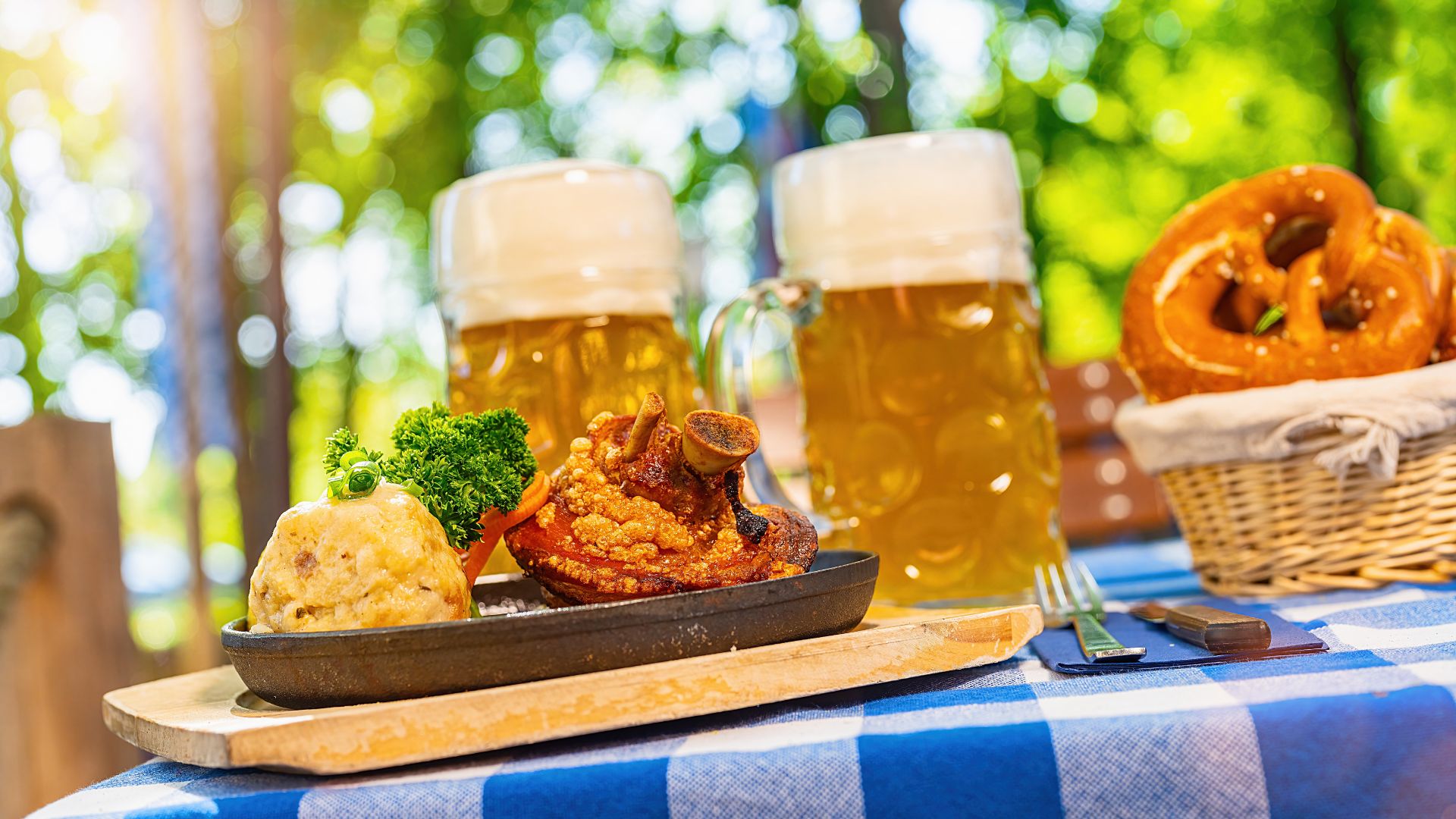
Schweinshaxe, the roasted pork knuckle, is the single most iconic main course dish in Bavarian cuisine and one of the most celebrated and most imitated meat preparations in all of Germany. It is a dish of extraordinary primal satisfaction and considerable technical cooking skill.
A properly prepared Schweinshaxe requires long, slow cooking to render the collagen-rich pork shank into yielding, falling-apart tenderness while simultaneously achieving a crackling skin of shattering, golden, blistering crispness. Getting both elements right simultaneously is the mark of an excellent Bavarian cook.
Schweinshaxe is found on the menu of virtually every traditional Bavarian Gasthof and beer garden restaurant throughout the state. The version served at the Hofbräuhaus in Munich is enormously famous but the most authentic and most memorable versions are often found in smaller, family-run rural Bavarian inns away from tourist areas.
The best time to eat Schweinshaxe is in the cooler months of autumn and winter when the richness and warmth of the dish feel most appropriate and most genuinely satisfying. A crisp half-litre of dark Märzenbier alongside a perfectly prepared Schweinshaxe is one of the most complete and rewarding eating experiences in Germany.
Where to find the best Schweinshaxe: Traditional Bavarian Gasthöfe in Munich, Regensburg, and the Bavarian countryside. Avoid tourist-focused restaurants in favour of establishments where the local Bavarian clientele eats regularly throughout the week.
2. Weisswurst — Bavaria’s Most Distinctive Breakfast Sausage
Weisswurst is one of the most distinctive and most ceremonially precise foods in all of Germany. This pale, delicate veal and pork sausage seasoned with fresh parsley, lemon zest, mace, and cardamom is surrounded by a set of traditions and unwritten rules that Bavarians take with complete and utter seriousness.
The most important rule is timing. Weisswurst should never hear the midday church bells ringing. This tradition originated because the sausages were made fresh each morning without preservatives in the era before refrigeration, and eating them before noon was a practical necessity that has become a deeply cherished cultural ritual.
The complete Weisswurst breakfast consists of the sausages, sweet Bavarian mustard, a freshly baked Brezn pretzel, and a Weissbier wheat beer. The combination of delicate sausage, sweet mustard, chewy pretzel, and cloudy wheat beer creates a breakfast of remarkable harmony and deeply Bavarian character.
Weisswurst is best eaten at a traditional Munich Gasthof on a Sunday morning when the full ritual of the breakfast is observed and celebrated. The Augustiner restaurant near the Frauenkirche, the Weisses Bräuhaus, and numerous traditional neighbourhood Gasthöfe throughout Munich serve outstanding versions throughout the morning hours.
Where to find the best Weisswurst: Any traditional Munich Gasthof or Weissbierbrauerei serving breakfast. The Weisses Bräuhaus near Marienplatz is widely considered one of the finest and most authentic Weisswurst breakfast destinations in the entire city.
3. Sauerbraten — Germany’s Most Complex Pot Roast
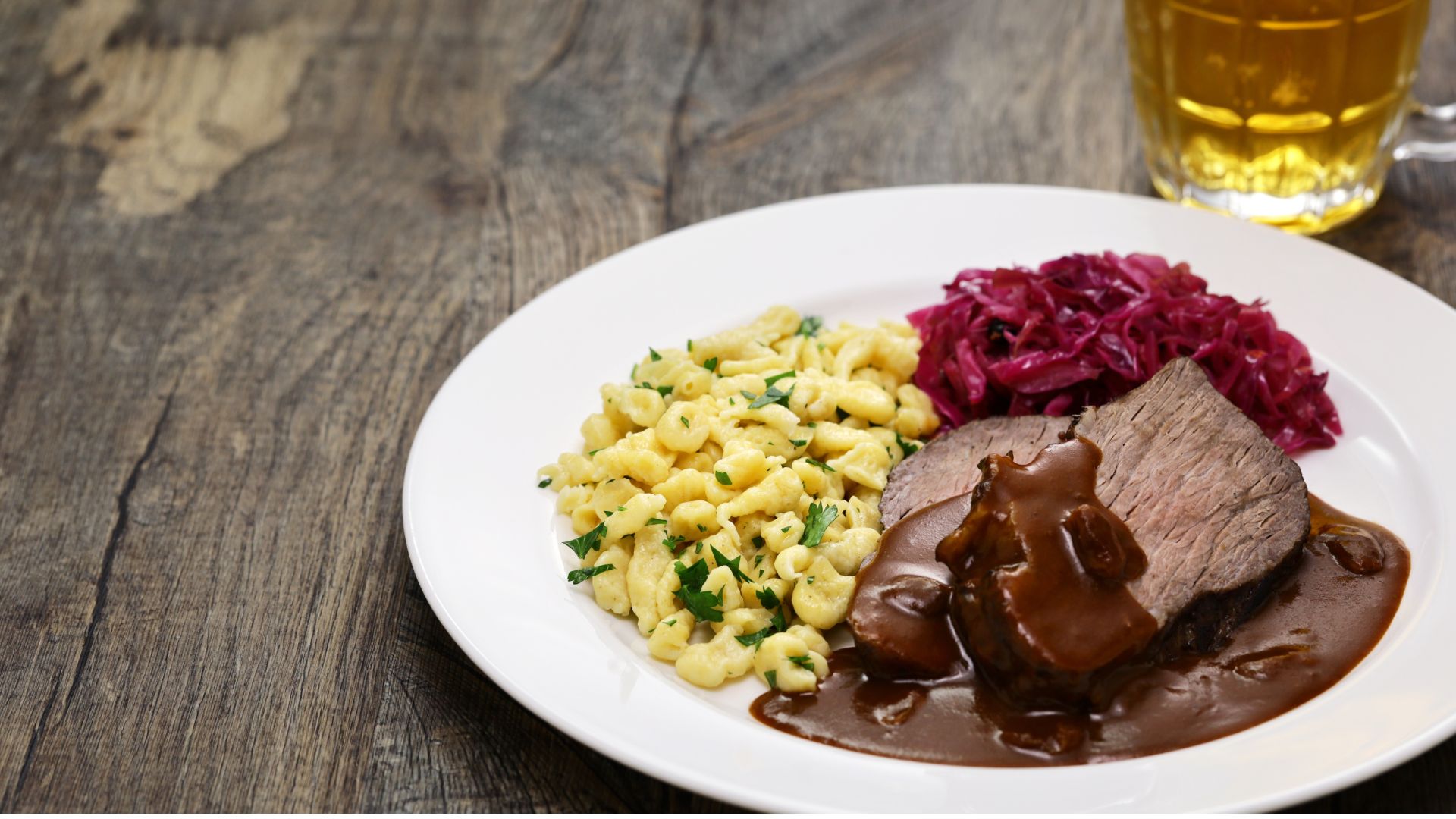
Sauerbraten is one of Germany’s greatest and most technically demanding traditional dishes. This pot-roasted beef, marinated for three to seven days in a mixture of vinegar, red wine, vegetables, bay leaves, and juniper berries, develops a flavour of extraordinary depth and complexity that is found nowhere else in European cooking.
The long marinade fundamentally transforms the beef. The acidity tenderises the meat fibres and permeates the entire roast with a tangy, aromatic complexity that distinguishes Sauerbraten from every other German pot roast. The resulting flavour is simultaneously rich, tangy, sweet, and deeply savoury in a completely unique way.
The traditional accompaniments of Sauerbraten are red cabbage braised with apple and cloves, and either potato dumplings or Spätzle pasta. This combination of the tangy marinated beef with the sweet-sour red cabbage and the starchy, sauce-absorbing dumplings creates one of Germany’s most harmonious and most satisfying complete meals.
Sauerbraten is found throughout Germany in numerous regional variations. The Bavarian version uses dark beer in the braising liquid, the Swabian version uses red wine, and the Rhineland version uses its characteristic raisins. Each regional interpretation is equally valid and equally worthy of trying and comparing during travels through Germany.
Where to find the best Sauerbraten: Traditional German Gasthöfe and Brauhäuser throughout the country. In Cologne, the traditional Altstadt brewery restaurants serve outstanding versions. In Munich, the Hofbräuhaus and numerous neighbourhood Gasthöfe offer excellent Sauerbraten throughout the year.
4. Bratwurst — Germany’s Most Beloved Street Food
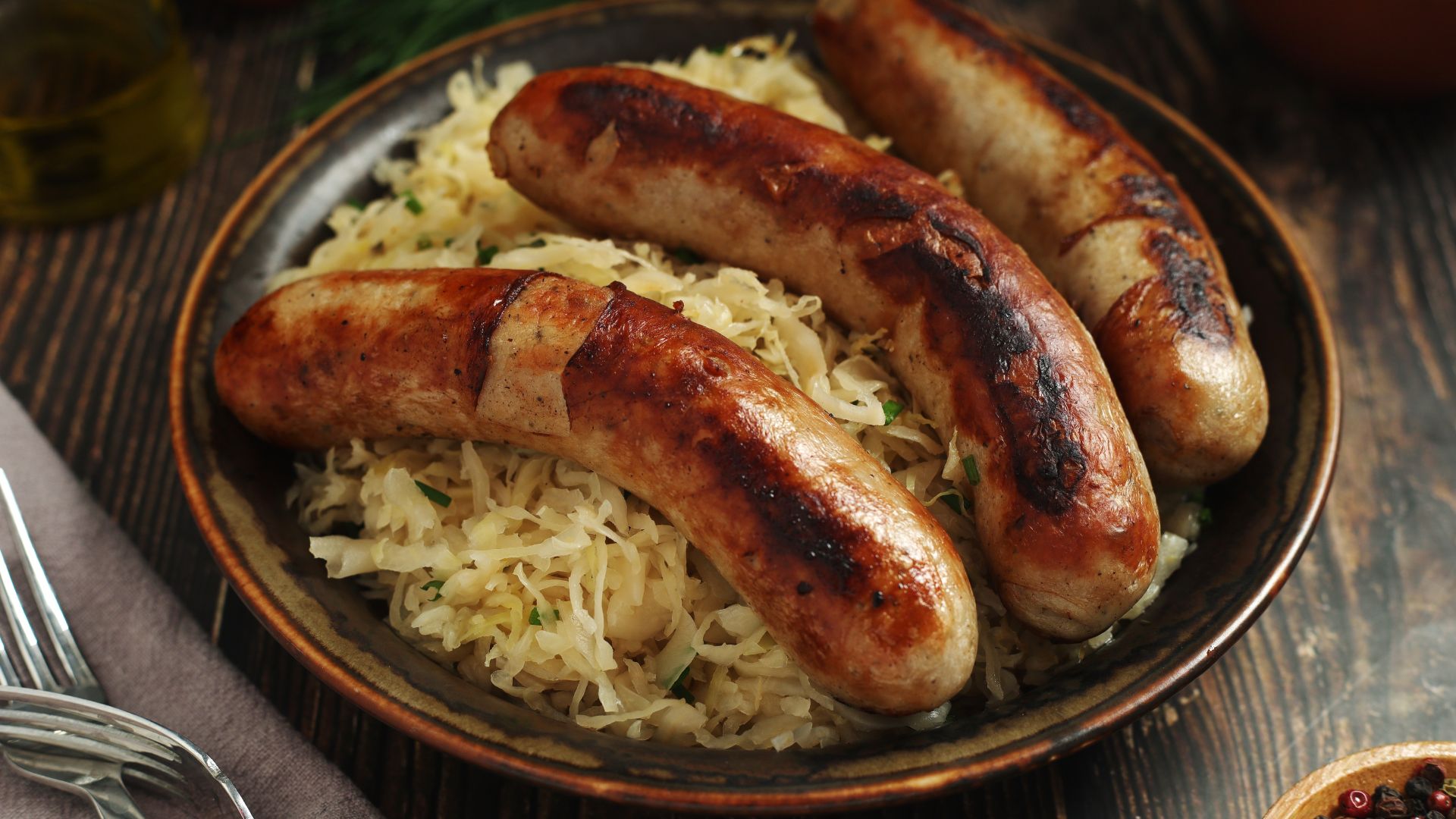
Bratwurst is the dish that most immediately and most universally represents Germany to the outside world. Yet behind this single word lies an extraordinary diversity of regional sausage traditions, each with its own ingredients, seasonings, smoking methods, and serving customs that make German bratwurst culture genuinely fascinating.
The Nuremberg Bratwurst is the most famous and most legally protected bratwurst in Germany. These small, finger-length pork sausages seasoned with marjoram are grilled over genuine beechwood charcoal and served in groups of six, eight, or twelve with sauerkraut on a tin plate. Their protected geographical indication is taken with absolute regional seriousness.
The Frankfurt Bratwurst, the Regensburg Bratwurst, the Coburg Bratwurst, and dozens of other regional variations each have their own passionate local defenders and their own distinct character. Exploring the bratwurst traditions of different German regions is one of the most enjoyable, most affordable, and most genuinely revealing ways to understand the country.
Bratwurst at its finest is always eaten standing at a street stall, at a market, or at an outdoor Christmas market counter. The combination of the smoky grilled sausage, the crisp bread roll, the sharp mustard, and the cold outdoor air creates a sensory experience that no restaurant version, however excellent, can fully replicate.
Where to find the best Bratwurst: Nuremberg Hauptmarkt stalls for the authentic Nuremberg version. Erfurt cathedral steps for Thuringian Rostbratwurst. Any German Christmas market for the most atmospheric bratwurst experience available during the winter months.
5. Maultaschen — Swabia’s Magnificent Pasta Pockets
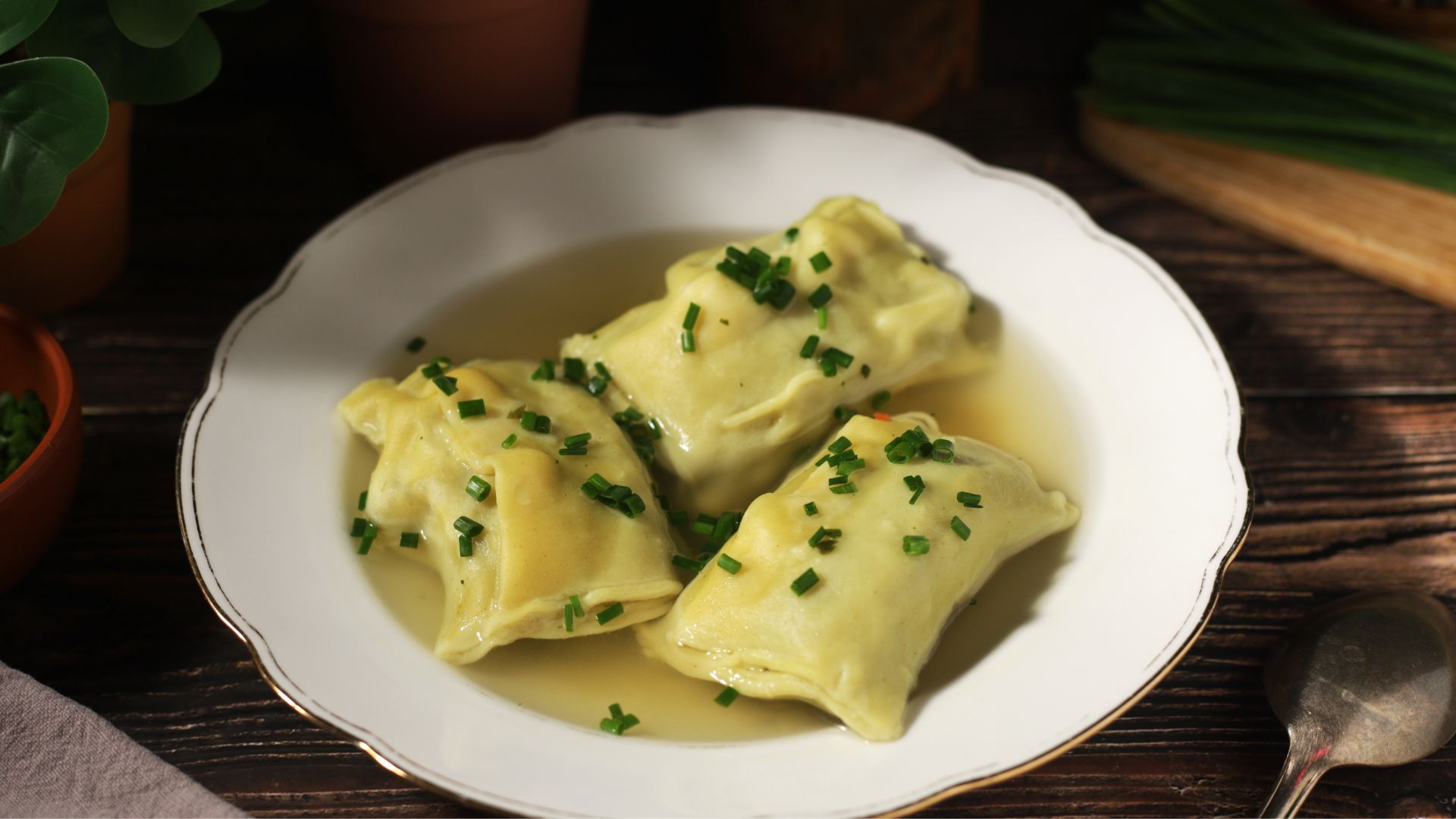
Maultaschen are the most beloved and most distinctive pasta dish in German cuisine and the crowning achievement of the Swabian cooking tradition. These large pasta pockets stuffed with minced meat, spinach, onions, and breadcrumbs are sometimes called Swabian ravioli and are one of Germany’s most underrated traditional dishes.
The legend surrounding Maultaschen is one of Germany’s most charming food stories. The monks of Maulbronn monastery allegedly invented them to hide minced meat inside the pasta filling and disguise it from God during the Lenten meat fast. Whether historically accurate or not, the story adds a delightful dimension to every serving.
The quality of Maultaschen depends entirely on the quality of the pasta and the generosity of the filling. The best versions are made with hand-rolled pasta of appropriate thinness enclosing a filling that is well-seasoned, substantial, and genuinely flavourful. Mass-produced versions available in supermarkets throughout Germany are a pale shadow of the genuine article.
Finding excellent Maultaschen requires eating in traditional Swabian restaurants in Stuttgart, Tübingen, or the Swabian Alb region. The dish is so deeply embedded in Swabian identity that it was added to the list of Baden-Württemberg cultural heritage in 2009, a recognition of its significance that local Swabians consider entirely justified and overdue.
Where to find the best Maultaschen: Traditional Swabian Gasthöfe and Weinstuben in Stuttgart, Tübingen, and the surrounding Swabian Alb region. The Stuttgart Markthalle also sells freshly made Maultaschen from specialist food producers throughout the week.
6. Spätzle — The Essential Swabian Pasta
Spätzle are the most versatile and most beloved pasta in Germany and the foundation of Swabian cuisine. Made from a simple batter of flour, eggs, salt, and water scraped through a Spätzle press or a colander directly into boiling salted water, they are found on virtually every menu throughout Baden-Württemberg and Bavaria.
Fresh Spätzle has a texture entirely unlike dried pasta. Soft, slightly chewy, and with an eggy richness from the generous use of eggs in the batter, they absorb sauces and gravies with outstanding efficiency and create a side dish of deeply satisfying comfort and substance that complements roasted meats perfectly.
Käsespätzle is the most celebrated preparation of Spätzle and arguably the finest comfort food in the entire German culinary tradition. Freshly cooked Spätzle layered with grated Emmental or Bergkäse mountain cheese and topped with an enormous mound of deeply caramelised golden fried onions is a dish of extraordinary and entirely simple perfection.
Spätzle appears on restaurant menus throughout southern Germany as the default side dish alongside roasted meats, game dishes, and Sauerbraten. Finding a restaurant that makes them fresh rather than using pre-packaged Spätzle is always worth the additional effort and invariably produces a significantly more satisfying and more flavourful result.
Where to find the best Spätzle: Any traditional Swabian restaurant in Stuttgart or Tübingen. The Brauhaus Schönbuch in Stuttgart is widely regarded as serving outstanding fresh Spätzle. In Bavaria, look for restaurants that specify frische Spätzle on their menu to ensure the fresh-made version.
7. Rouladen — Germany’s Most Comforting Sunday Roast
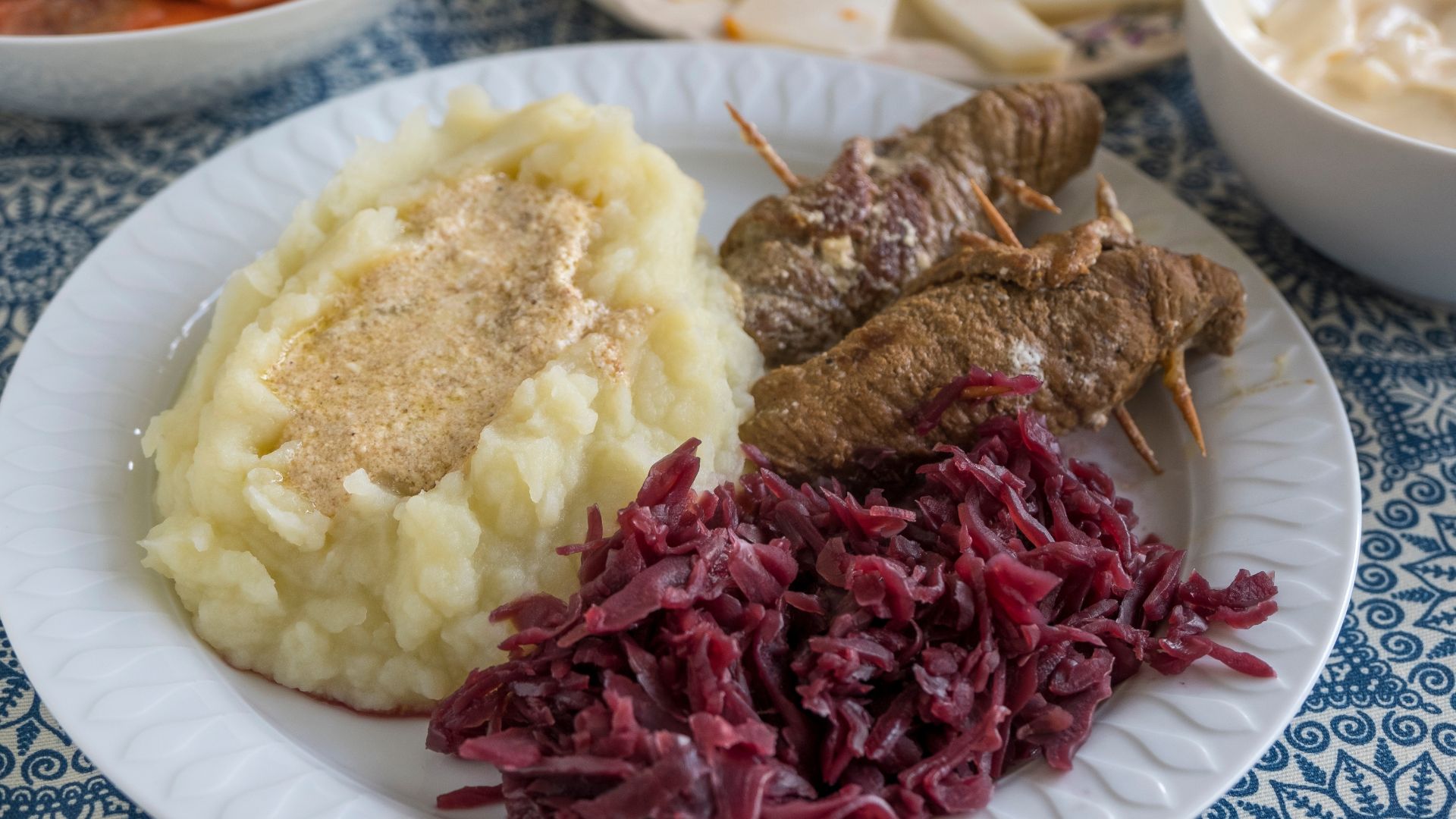
Rouladen is one of Germany’s most beloved and most universally prepared traditional dishes, found in every German regional cuisine from Bavaria to Schleswig-Holstein. These thin slices of beef spread with mustard, wrapped around smoked bacon, pickled cucumber, and onion, then braised in a rich dark stock are the essence of German Sunday cooking.
The preparation of Rouladen is a meditative and deeply satisfying process. Each beef slice is spread generously with sharp mustard, layered with smoked bacon, a strip of pickled cucumber, and raw onion, then rolled tightly, secured with toothpicks or kitchen string, and browned thoroughly on all sides before the long braising begins.
The braising liquid of Rouladen, reduced and enriched with the beef juices, mustard, and the pickle flavours leaching from the filling, creates a dark and intensely flavoured sauce of remarkable depth. This sauce, poured generously over the finished Rouladen, is as important and as delicious as the meat rolls themselves.
The best Rouladen are made with thinly sliced topside or silverside beef and require a braising time of at least 90 minutes to develop full tenderness and flavour. Many German home cooks consider Rouladen their finest Sunday dish and prepare them with the kind of careful attention and pride that the dish fully justifies and deserves.
Where to find the best Rouladen: Traditional German Gasthöfe and family restaurants throughout the country. Sunday lunch menus at rural Gasthöfe in Bavaria, Saxony, and Thuringia often feature Rouladen as the centrepiece dish of the weekly Sunday meal.
8. Grüne Soße — Frankfurt’s Most Beloved Dish
Grüne Soße, Frankfurt Green Sauce, is the most fiercely defended and most passionately celebrated regional dish in Hesse. This cold herb sauce made from exactly seven specific fresh herbs is considered the definitive dish of Frankfurt and its surrounding region during the spring and summer herb season.
The seven herbs of authentic Grüne Soße are non-negotiable and deeply sacred to Frankfurt cooks: borage, chervil, cress, parsley, salad burnet, sorrel, and chives. The precise mixture, the freshness of the herbs, and the quality of the sour cream and hard-boiled eggs used in the sauce are matters of intense local pride and ongoing debate.
The herbs are finely chopped and mixed with sour cream, hard-boiled eggs, oil, and a small amount of vinegar to create a sauce of fresh, bright, and deeply herbal character. Served cold alongside warm boiled potatoes and additional halved hard-boiled eggs, it provides a light and refreshing meal of genuine and distinctive Frankfurt character.
Goethe, Germany’s greatest writer and a native of Frankfurt, reportedly loved Grüne Soße above all other foods. The city celebrates its most famous dish annually at the Grüne Soße Festival in the Roßmarkt square, and the Goethe House museum shop even sells Grüne Soße herb seeds as a distinctively Frankfurt souvenir.
Where to find the best Grüne Soße: Traditional Frankfurt restaurants in the Sachsenhausen district and the old town area. The restaurant Metropol near the Römer and the traditional apple wine taverns of Sachsenhausen serve excellent versions during the spring and summer herb season.
9. Flammkuchen — The Alsatian-German Thin Crust Classic
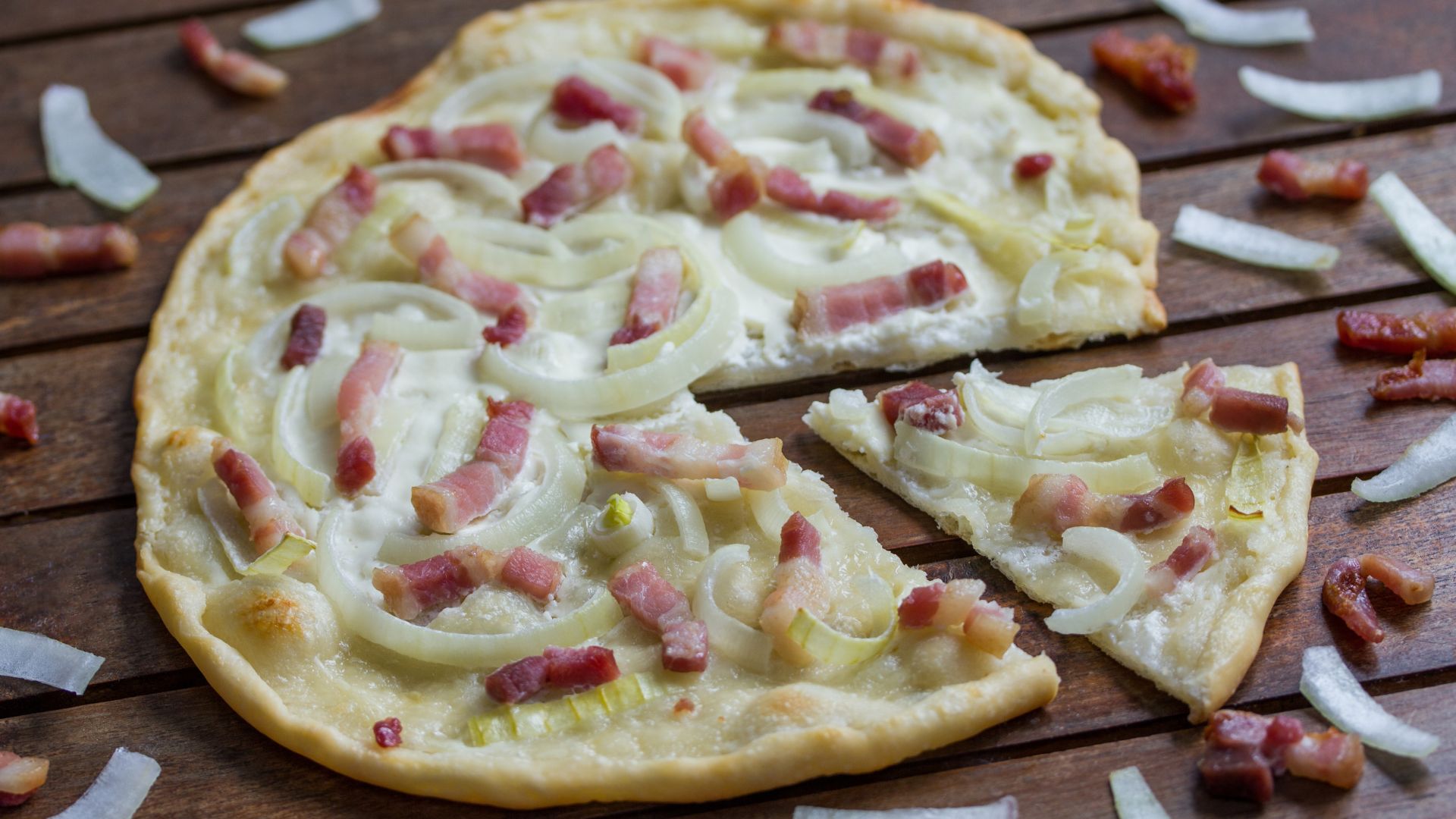
Flammkuchen is one of the simplest and most perfectly conceived dishes in the German culinary tradition. This ultra-thin flatbread tart topped with crème fraîche, finely sliced raw onions, and smoked bacon lardons, baked in a screaming hot wood-fired oven until the edges are charred and the topping is bubbling, is a dish of complete sensory pleasure.
The name Flammkuchen means flame cake, referring to the traditional method of testing wood-fired oven temperature by inserting the thin dough and observing how quickly it cooked. If the oven was hot enough to cook the Flammkuchen in just two or three minutes, it was ready for bread baking.
The crème fraîche topping of Flammkuchen must be spread thinly and evenly to the very edges of the dough. Too much topping creates a soggy and heavy result entirely contrary to the dish’s essential character of lightness and crispness. The ideal Flammkuchen is thin, blistered, slightly charred at the edges, and eaten immediately from the oven.
Variations on the classic Flammkuchen include versions with Munster cheese, with mushrooms and herbs, with smoked salmon, and with sweet toppings of apple and cinnamon for a dessert version. Each variation is enjoyable but the classic version of crème fraîche, onion, and bacon remains the most pure and most satisfying of all possible preparations.
Where to find the best Flammkuchen: Wine estate restaurants and Weinstuben throughout Baden and the Palatinate. The wine villages of the Kaiserstuhl near Freiburg and the Palatinate wine route serve outstanding versions throughout the year at affordable prices in deeply atmospheric settings.
10. Dresdner Stollen — Germany’s Most Famous Christmas Bread
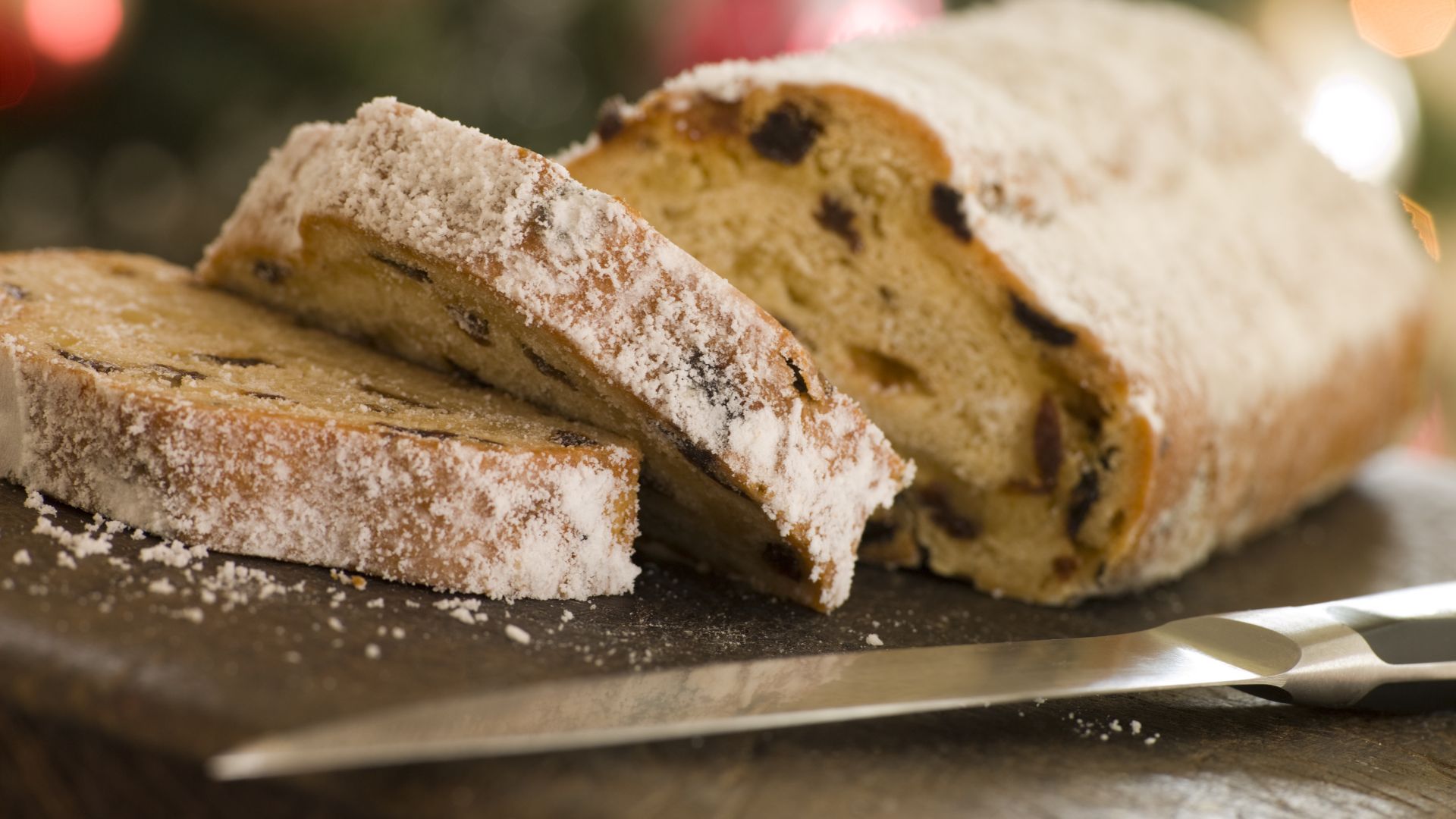
Dresdner Stollen is the most celebrated and most carefully regulated baked product in Germany and one of the most internationally recognised Christmas foods in the entire European baking tradition. Its history, its precise recipe requirements, and its associated festivals make it one of the most culturally significant foods in the German culinary calendar.
Stollen is a densely enriched yeast bread made with generous amounts of butter, candied orange and lemon peel, raisins, almonds, and a core of marzipan. The finished loaf is drenched in melted butter while still warm and then buried under a thick coating of icing sugar that gives it its characteristic and beautiful white appearance.
The Stollen should be made at least two to three weeks before Christmas and allowed to mature. During this resting period the butter, sugar, and fruit flavours meld and deepen in a way that transforms the freshly baked loaf into something far more complex and satisfying. Cutting the first slice of a well-matured Stollen is one of Christmas’s finest food moments.
The annual Dresden Stollenfest in December is one of Germany’s most atmospheric and most distinctively local Christmas celebrations. A ceremonial Stollen of several tonnes is carried through the streets, blessed, and sliced in a tradition that celebrates both the baking craft and the cultural identity of Germany’s most famous Christmas bread city.
Where to find the best Dresdner Stollen: Directly from authorised Dresden bakeries including Bäckerei Wippler, Backhaus Habel, and the numerous specialist Stollen producers at the Dresden Christmas market. The official Dresdner Stollen seal guarantees authenticity and genuine traditional quality.
11. Schwarzwälder Kirschtorte — Germany’s Most Famous Cake
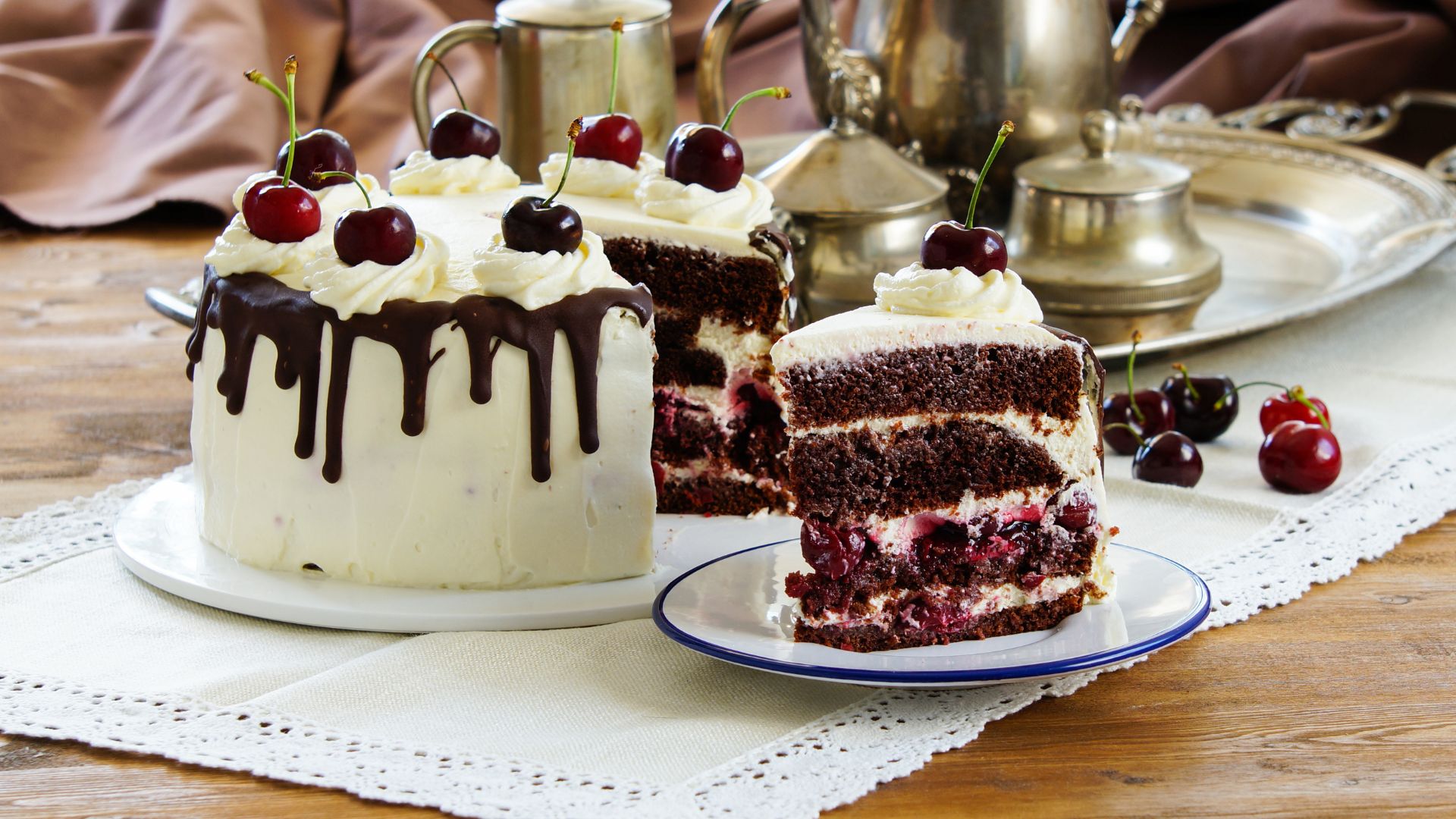
The Schwarzwälder Kirschtorte, the Black Forest Gateau, is Germany’s most internationally recognised cake and the most celebrated product of the Baden baking tradition. Its combination of chocolate, cream, cherries, and Kirschwasser cherry schnapps creates Germany’s most indulgent and most imitated dessert preparation.
An authentic Black Forest Gateau consists of several specific layers each of which is essential to the genuine article. Moist chocolate sponge soaked in Kirschwasser, fresh whipped cream, sour cherries, more Kirschwasser-soaked sponge, more cream, and a final decoration of piped cream rosettes, whole cherries, and generous dark chocolate shavings.
The best versions of the cake are made with fresh double cream whipped to soft peaks rather than the stabilised UHT cream used in industrial versions. The difference in texture, flavour, and overall eating experience between a freshly made authentic version and a mass-produced imitation is so dramatic as to make them virtually different cakes.
Finding genuine Schwarzwälder Kirschtorte in the Black Forest itself, in the café culture of Freiburg, or in any of the traditional Black Forest resort towns provides the most authentic and most memorable experience of Germany’s most famous cake. The Café Schäfer in Triberg, claiming to hold the original recipe, is a famous specialist destination.
Where to find the best Black Forest Gateau: Traditional Black Forest cafés in Triberg, Titisee, and Freiburg. Look for versions made with fresh cream and genuine Kirschwasser. Avoid versions in tourist restaurants that use canned cherries and imitation cream as these bear no relationship to the genuine article.
12. Lebkuchen — Nuremberg’s Legendary Christmas Gingerbread

Nuremberg Lebkuchen are Germany’s most celebrated and most historically significant Christmas biscuits and one of the most carefully protected geographical food indications in Germany. These dense, elaborately spiced gingerbread biscuits have been produced in Nuremberg for over six centuries and remain the city’s most internationally famous food product.
The Nuremberg Lebkuchen recipe uses a complex mixture of spices including anise, coriander, cloves, allspice, cardamom, ginger, and cinnamon combined with nuts, candied citrus peel, and honey. This extraordinary spice mixture creates a depth and complexity of flavour that distinguishes genuine Nuremberg Lebkuchen from all inferior imitations throughout the world.
The Nuremberg Christmas Market, the most famous Christmas market in Germany, is the finest and most atmospheric place to buy genuine Nuremberg Lebkuchen. The specialist Lebkuchen stalls at the market sell fresh biscuits from traditional family bakeries and provide the most memorable and most authentic Lebkuchen purchasing experience available anywhere.
Outside the Christmas season, Nuremberg Lebkuchen are available year-round from specialist bakeries and from the famous Lebkuchen-Schmidt shops throughout Germany and online. However the experience of buying them warm and fresh from a Christmas market stall in Nuremberg on a cold December evening remains entirely unrivalled and genuinely irreplaceable.
Where to find the best Lebkuchen: Nuremberg Christmas Market and specialist Lebkuchen bakeries including Lebkuchen-Schmidt and Lebkuchen Wolf in Nuremberg. Purchase directly from the market stalls for the freshest and most authentic version of Germany’s most famous Christmas biscuit.
Practical Tips for Eating Traditional German Food
Enjoying traditional German food can be a delightful experience, but practical tips help travelers navigate menus, portion sizes, and local dining customs. Knowing how to order enhances every culinary adventure.
From trying regional specialties and understanding mealtime etiquette to finding authentic eateries and managing costs, these tips guide travelers to savor German cuisine confidently. Following them ensures a delicious, memorable, and stress-free dining experience.
| Category | Details |
| Best Markets | Weekly Wochenmarkt markets in every German town for the freshest and most affordable regional food |
| Lunch Strategy | Order the Mittagstisch daily lunch special for the best value traditional German main course available |
| Beer Pairing | Weissbier with Weisswurst, dark Märzenbier with Schweinshaxe, Kölsch with Rhineland dishes throughout |
| Seasonal Eating | Asparagus in spring, Matjes herring in early summer, game dishes in autumn, Stollen in December |
| Finding Authentic Food | Look for restaurants where German locals eat regularly rather than tourist-focused establishments |
| Supermarkets | REWE and Edeka stock genuine regional products for self-catering and discovering local German food varieties |
Takeaways from Germany’s Traditional Dishes
Traditional German food represents one of Europe’s most genuinely rewarding and most underappreciated culinary journeys. From the crackling Schweinshaxe of a Munich beer garden to the delicate herb freshness of a Frankfurt Grüne Soße, from the smoky intensity of a Nuremberg Bratwurst to the buttery richness of a genuine Dresdner Stollen, each dish tells a story of place, season, and deep cultural identity.
The key to eating German food well is always to seek the most local and most authentic version of any given dish. The Bratwurst grilled over genuine beechwood at a Nuremberg market stall, the Weisswurst eaten before noon in a Munich Gasthof, and the Maultaschen made fresh by hand in a Swabian kitchen are all entirely different and infinitely superior experiences to the compromised tourist versions.
Germany rewards food-curious travellers who take their eating seriously with an extraordinary return of genuine flavour, cultural insight, and memorable experience. Every traditional dish on this list is worth trying in its most authentic form, in its most appropriate regional setting, and ideally with the local beer or wine that has accompanied it for centuries.
Hi, I’m Preeti Negi, a content writer who loves mixing creativity with smart strategy.
I have 3 years of experience writing about travel, digital marketing, and study abroad topics. I create content that is easy to read, engaging, and designed to connect with people while also performing well on Google.
When I’m not writing, I enjoy exploring new trends, learning new things, and thinking about fresh ideas for my next piece.
